Project notes
On the workbench
A few notes from projects I’m actively developing, testing and learning from.
-
FieldMesh
-
FieldNode — Sync and Power-Off Fixes
- Readings now sit on a fixed UTC clock grid, so nodes no longer drift into the sync window together
- An alarm that comes due during a wake is now handled, not wiped
- A node never powers off over a pending RTC alarm
- A node that loses its clock listens for the hub in short bursts and recovers by itself
-
FieldHub V2 — Sync Sweep Results
- Two nodes against Hub V2, with a hub boot delay injected from 0 to 85 s
- Original timing: both nodes joined up to a 30 s delay, neither from 35 s
- Hub woken 45 s before the slot: the edge moved to 70 s, as the timing model predicts
- A missed window costs time, not data: queued readings upload at the next one
-
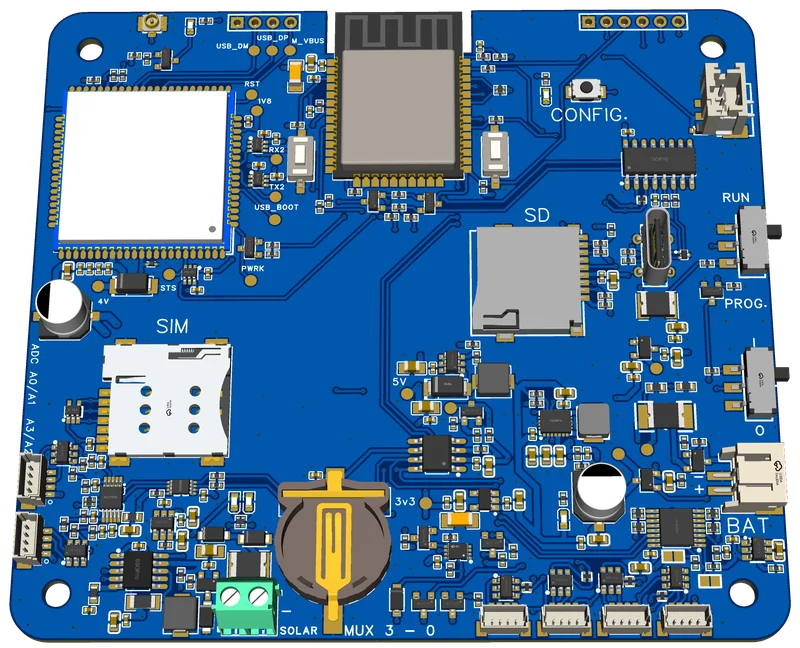
FieldHub V2 — Sensor Bring-Up
- Four I²C sensor ports verified with an SHT40, including at 400 kHz
- ADS1015 inputs within about 1% of a reference meter, no crosstalk
- Reed input works, but its GPIO moves in the next revision
- Still to test: ESP-NOW, RTC backup retention, longer wake cycles
-
FieldHub V2 — Scaling the Network
- First test: controlled hub boot delays, two nodes against Hub V2
- Goal: measured node capacity instead of theoretical estimates
-
FieldNode V4 — PCB Layout Complete
- Layout complete and prototype manufacturing package prepared
- Final review fixes: SDI-12 resistor value, reverse-battery protection
-
FieldMesh — Updating the Public Project
- New FieldHub V2 renders on the FieldMesh pages
- Case study checked against the repositories: built, tested, planned
-
FieldMesh Node V4
The Node V4 schematic has completed a major review cycle and is moving toward PCB layout.
-
FieldHub V2
FieldHub V2 has moved through final prototype-production checks.
-
FieldMesh Platform
FieldMesh completed a substantial backend and firmware hardening pass.
-
-
Auris
-
Auris — Choosing Parts for the Audio Front End
- Every fitted part in the audio front end has an exact LCSC part number, test pads aside
- Signal-path capacitors are C0G, and bias and DC-blocking capacitors are tantalum
- One ceramic that didn't belong on a bias node was caught and replaced
- Next: the same check for the power and LTE sections
-
Auris — From Concept to Hardware
- Audio front end, solar power and LTE sections defined
- Next: MCU and processing architecture
-
-
Sketch Surf
-
Sketch Surf
Sketch Surf reached version 1.4.0 this week.
-
-
Auris
-
Auris
Auris is an early-stage concept for a compact autonomous acoustic recorder focused on low-power field deployment.
-
Follow along
Get new notes as they’re posted
Add the RSS feed to a reader app, such as Feedly or NetNewsWire, and new notes arrive there automatically.
RSS feed address
https://tomarmstrong.net/notes/feed.xml